What I Learnt from Grandpa Warren
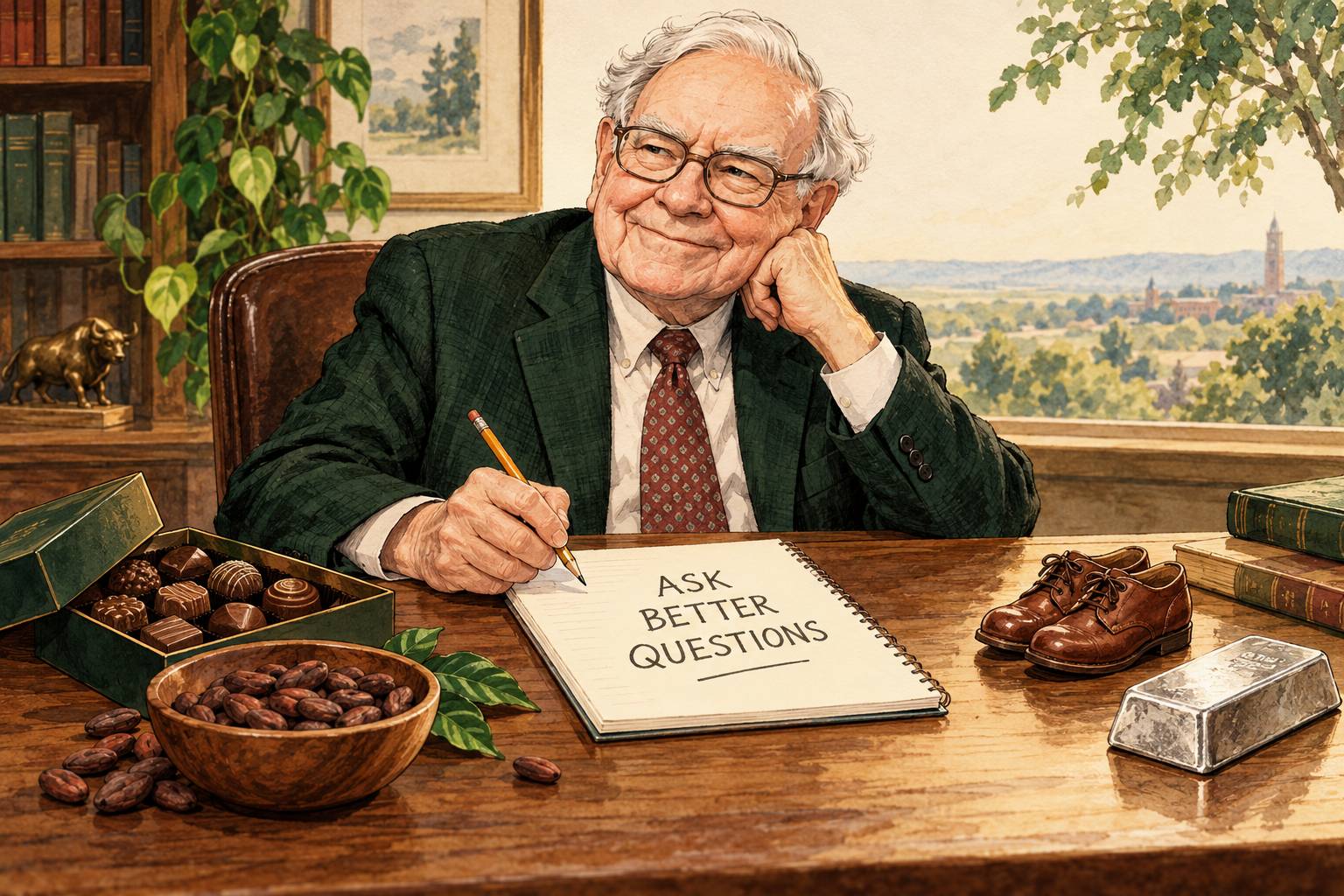
If you know the Kardashians but don’t know Warren Buffett, we cannot be friends.
I have to be honest: that’s a dealbreaker. But I’m generous, so here’s another chance.
Allow me to introduce my spiritual grandfather: Grandpa Warren.
He doesn’t know I exist. We are working through that.
Grandpa Warren is one of the greatest investors of all time. Yet what interests me most is how he thinks—and what he admits when he gets something wrong.
His record offers more than instructions about what to buy. It offers better questions to ask before buying anything.
First, the familiar Grandpa Warren
The familiar Buffett lessons begin with Benjamin Graham’s value-investing approach: work out what a business is worth, then avoid paying too much for it. Charlie Munger helped deepen his appreciation of business quality: a wonderful business at a sensible price could be a better investment than a mediocre one at a bargain.
In real life, finding a wonderful company at a wonderful price? Well, good luck. It reminds me of finding the man of my dreams. The checklist is excellent. The available candidates are another matter.
For a business, my simplified checklist looks something like this:
- A business you can understand.
- Consistent earning power and strong returns on equity.
- Little debt, or debt the business can comfortably manage.
- A competitive advantage that has a reasonable chance of lasting.
- Capable, honest management.
- A price that makes sense for what you are buying.
That is a starting point, not a valuation.
Once you find such a company, think like an owner, not just someone waiting for the next person to pay more. A falling share price can be an opportunity, provided the business still deserves your confidence and the price offers value.
That last part matters. Buying more simply because everyone else is selling is not a strategy. Neither is treating a stock like a religion.
Chill. Whatever my convictions in life, I remain agnostic in stocks. If the facts change, I want the freedom to change my mind.
Now, let’s meet the less familiar Grandpa Warren. His record includes more than buying wonderful businesses and waiting. There was cocoa. There was silver. And there were mistakes expensive enough to make the rest of us feel slightly better about ourselves.
Slightly.
The cocoa trade
In 1954, chocolate company Rockwood made an unusual offer: give us one share of our stock, and we will give you 80 pounds of cocoa beans.
Buffett spotted an opportunity. Buying a share cost less than he could get by selling the beans he would receive in exchange.
So he bought the shares, exchanged them for the cocoa and sold the cocoa for more than he had paid.
No, Grandpa Warren was not dragging sacks of beans around New York. He handled the paperwork. The chocolate was somebody else’s problem.
This is called arbitrage: taking advantage of a difference in prices.
The lesson? Don’t just ask whether something looks cheap. Ask how you could actually make money from it—and what could go wrong.
The wonderful business he almost missed
When See’s Candies came up for sale in 1972, the sellers wanted $40 million, including $10 million of surplus cash. That put the effective asking price for the business at $30 million.
Buffett and Munger said $25 million was as high as they would go.
The sellers accepted, and Blue Chip Stamps, then a Berkshire affiliate, bought control. Looking back, Buffett described his insistence on that price as dumb: the deal could easily have fallen through.
Why did See’s prove so valuable?
By the end of the period covered in his 1991 letter, the business needed only $25 million of net worth to operate—just $18 million more than its starting base. Meanwhile, it had distributed $410 million in pretax profits to Blue Chip and Berkshire, available for redeployment after taxes.
The attraction was not just how much See’s earned. It was how little extra money the business needed to keep earning.
Some businesses grow and keep asking their owners to feed them. See’s left plenty on the table for its owners to use elsewhere.
Price discipline matters. But so does understanding what a great business is worth. Winning the negotiation is not the same as making the best investment.
This is not permission to pay whatever a seller asks. It is a reminder to check whether your valuation has missed something important.
The shoes that cost more than cash
In 1993, Berkshire bought Dexter Shoe using Berkshire shares valued at $433 million.
Buffett misjudged how well Dexter’s competitive advantage would withstand foreign competition. In his later account, the business’s value fell to zero.
Painful enough. But there was another problem: the Berkshire shares he had given away kept growing in value.
In his 2014 shareholder letter, Buffett said those shares were then worth about $5.7 billion. That was not an additional cash payment. It was the later value of the ownership he had surrendered.
See’s showed what a durable competitive advantage could make possible. Dexter showed the cost of assuming one would last.
A strong record tells you what a business has done. You still have to investigate what could undermine it.
And when you exchange one asset for another, ask two questions: what am I buying, and what am I giving up?
Missing Amazon and Google
Buffett’s missed opportunities were not all the same mistake.
With Amazon, he acknowledged underestimating what Jeff Bezos could accomplish. With Google, the admission was different: Berkshire should have recognised the opportunity. GEICO was already buying its advertising and seeing the economics firsthand.
But let’s be careful here. Not buying a future winner is not automatically a mistake. Otherwise, every stock we didn’t buy before it multiplied would become evidence against us.
An exhausting way to live. Also, a very long list.
The harder question is whether you overlooked evidence you could reasonably have understood at the time.
“I don’t understand it” is a perfectly good reason not to buy. It can also be the beginning of research, rather than the end of the conversation.
Learn before you buy. And keep learning even when you don’t buy.
And then there was silver
Yes, silver.
Berkshire purchased 111.2 million ounces during 1997. By February 3, 1998, it reported owning 129.71 million ounces, including purchases still awaiting delivery.
The argument was specific: demand was exceeding mine production and reclaimed supplies, drawing down inventories. Buffett and Munger believed a higher price would eventually be needed to bring supply and demand back into balance.
Buffett explicitly said inflation expectations played no part in that calculation.
So, before anyone recruits Grandpa Warren into a general warning about paper money, let’s read what Grandpa actually said.
This was a particular supply-and-demand thesis. The lesson is to understand the reasoning behind a position before borrowing someone else’s conviction.
And the fact that Buffett could evaluate a cocoa transaction, a candy business and a silver position does not make them the same exercise. Each required different evidence.
Flexibility still needs homework.
What I am taking from Grandpa
I am taking better questions from Grandpa, not a shopping list.
What makes this business valuable? How much new money does it need? What could destroy its advantage? What am I giving up to own it?
You can admire an investor without turning every decision into a commandment. You can learn from his mistakes without pretending you would have avoided them. And you can change your mind without abandoning your principles.
Take notes:
- Understand the business before falling in love with the price.
- Check how much new money growth requires.
- Know what would prove your investment thesis wrong.
- Count what you are giving up, not only what you are getting.
- Understand the reasoning before borrowing the conviction.
If you are currently a zerollionaire, welcome. No minimum net worth is required to start asking better questions.
Subscribe to Nagham Writes for more market stories, practical lessons and the occasional unsolicited relationship analogy.
Warmly, Nagham
For educational purposes only, not personalised investment advice. Historical examples do not predict future returns.